Imagine preparing a gourmet meal in your open-concept kitchen, the aromas of your culinary creations wafting freely, filling your entire living space. While delightful during cooking, these lingering smells, grease, and smoke can quickly become unwelcome guests. This is where the right island range hood becomes indispensable. More than just a functional appliance, an island range hood is a vital component for maintaining air quality and can serve as a stunning focal point, seamlessly blending style with powerful ventilation. With over a decade of hands-on experience in kitchen ventilation, I’ve seen firsthand how the perfect island range hood can transform an open kitchen from merely beautiful to truly brilliant.
Understanding Island Range Hoods for Open-Concept Spaces
An island range hood is a specialized ventilation system mounted directly to the ceiling above a cooktop located in a kitchen island. Unlike wall-mounted hoods that attach to a wall, these units are freestanding, demanding robust ceiling support and careful installation. Their central placement makes them a dominant visual element, offering a chance to enhance your kitchen’s aesthetic while providing critical air purification.
Why are island range hoods essential for open-concept kitchens? In these layouts, without walls to contain cooking byproducts, odors, steam, and grease can spread throughout your home much faster. An effective island range hood actively captures and removes these elements at their source, preventing them from settling on furniture, fabrics, and surfaces. This not only promotes a healthier cooking environment but also preserves the fresh, inviting atmosphere of your entire living area.
The fundamental choice for any range hood, especially an island model, lies between ducted and ductless ventilation. Ducted hoods vent cooking contaminants outdoors through a system of ducts, offering superior performance in removing odors, smoke, and grease. For open-concept kitchens, where maintaining pristine air quality is paramount, a ducted system is almost always the recommended choice. Ductless hoods, on the other hand, filter the air using charcoal filters and then recirculate it back into the kitchen. While easier to install as they don’t require external venting, they are less effective at removing heat and moisture and typically require more frequent filter replacement.
Key Factors to Consider When Selecting an Island Range Hood
Choosing the ideal island range hood involves balancing performance, aesthetics, and practicality. As a technician who has installed and serviced countless models, I’ve learned that several key factors dictate long-term satisfaction.
Suction Power (CFM): Ensuring Optimal Ventilation
Table is empty.The effectiveness of any range hood is measured by its Cubic Feet per Minute (CFM) rating, indicating how much air it moves in one minute. For open-concept kitchens, higher CFM is generally necessary due to the larger, unconfined air volume. For gas cooktops, a good rule of thumb is to calculate 100 CFM for every 10,000 BTUs your stove produces; simply add the BTU output of all burners and divide by 100 to find your minimum CFM. For electric cooktops, you generally need about 10 CFM per inch of cooktop width.
Another method involves calculating your kitchen’s total volume (Length x Width x Height in feet). The National Kitchen and Bathroom Association (NKBA) recommends that a range hood should be capable of exchanging the air in your kitchen at least 15 times per hour. To calculate, multiply your kitchen’s cubic feet by 15, then divide by 60 minutes to get the minimum CFM. Additionally, because island hoods are freestanding and more susceptible to cross-drafts, it’s often advisable to multiply your calculated CFM by an additional factor of 1.2 to ensure adequate capture and exhaust. [cite: 3_search_result_2, 1_search_result_3, 2_search_result_3, 3_search_result_3, 4_search_result_3, 5_search_result_3]
> “In open-concept kitchens, people often underestimate the CFM required. The air has more room to escape, so you need a more powerful motor to effectively capture smoke and odors before they dissipate.” – Lien Nguyen, Senior Ventilation Engineer.
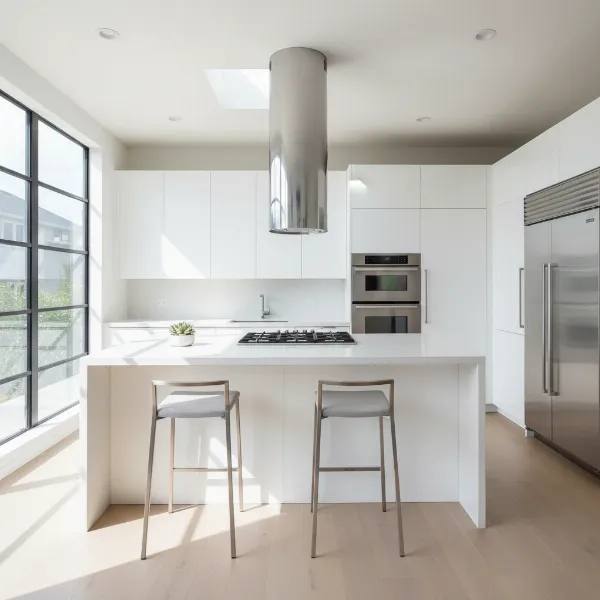 A sleek stainless steel island range hood hanging above a minimalist kitchen island cooktop in an open-concept living space, bright and inviting.
Noise Levels: Cooking in Peace
In an open kitchen, a loud range hood can quickly disrupt conversation and the overall ambiance. Noise levels are measured in sones, where a lower number indicates quieter operation. For comparison, one sone is roughly equivalent to the sound of a refrigerator hum, while 7 sones are comparable to normal conversation. Look for models rated at 3 sones or less for comfortable use in an open setting.
Several features can contribute to quieter operation. Range hoods with variable speed controls allow you to adjust the fan power to the minimum necessary, reducing noise for lighter cooking tasks. Baffle filters, commonly found in commercial-style hoods, not only capture grease more efficiently but also tend to be quieter than mesh filters and are often dishwasher-safe for easy cleaning. [cite: 4_search_result_4] For the absolute quietest experience, consider models with an external or inline blower, where the motor is located outside the kitchen area (e.g., in the attic or exterior wall), significantly reducing the noise heard at the cooktop.
Size and Design: A Seamless Integration
An island range hood should be at least as wide as your cooktop to ensure effective capture of smoke and steam. Many experts, myself included, recommend going a step wider – for example, a 42-inch or 48-inch hood for a 36-inch range – to provide an even larger capture area, especially for heavy cooking. [cite: 5_search_result_2] Deeper hoods also help contain rising cooking effluent before it can escape into the room. Island hoods typically range from 30 to 60 inches in width.
Proper mounting height is crucial for both performance and safety. Generally, island range hoods should be installed 24-30 inches above an electric or induction cooktop, and 30-36 inches above a gas cooktop. [cite: 2_search_result_2] Always check your specific model’s recommendations and local building codes. Beyond these practicalities, the design of your island hood is paramount. It will be a visual centerpiece in your open kitchen. Consider materials like stainless steel for a modern look, sleek glass canopies for an airy feel, or a combination that complements your overall kitchen aesthetic.
Material and Maintenance: Durability and Ease
The materials used in an island range hood impact both its appearance and longevity. Stainless steel is a popular choice for its durability, resistance to corrosion, and contemporary look. Glass elements can add a touch of elegance and help maintain an open, unobstructed view.
Filter type plays a significant role in maintenance.
- Baffle Filters: These are metal filters with a series of interlocking baffles that force grease-laden air to change direction, causing grease particles to condense and collect. They are highly efficient, durable, and often dishwasher-safe, making them very easy to clean.
- Mesh Filters: Made from layers of fine metal mesh, these filters trap grease effectively but can clog more easily than baffle filters and may require more frequent cleaning. Some are dishwasher-safe, but others may need hand-washing.
- Charcoal Filters: Used in ductless (recirculating) hoods, these filters absorb odors and smoke. They are not washable and need to be replaced periodically (typically every 3-6 months), adding to ongoing costs.
Regardless of the type, keeping filters clean is essential for optimal performance and reducing noise. Neglecting filter maintenance forces the motor to work harder, decreasing efficiency and increasing operational noise.
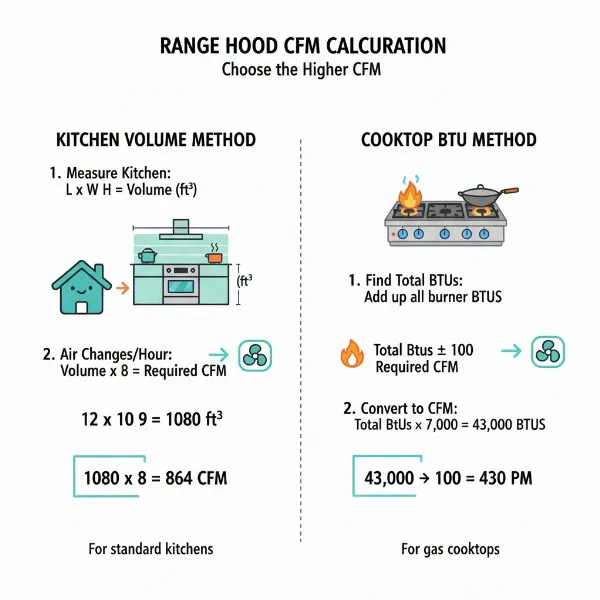 An infographic or diagram illustrating how to calculate CFM for a range hood based on kitchen size and cooktop BTU.
Smart Features: Modern Convenience
Modern island range hoods come equipped with a variety of features that enhance convenience and functionality:
- LED Lighting: Most contemporary hoods feature energy-efficient LED lights, often with multiple brightness settings, providing excellent illumination for your cooktop. Some even include a dim nightlight function.
- Control Options: Look for intuitive soft-touch controls, often integrated seamlessly into the hood’s design. Remote controls or even Wi-Fi-enabled smart features allow you to operate the hood from anywhere in your kitchen via a smartphone app.
- Timer and Auto-Shutoff: A timer function lets the hood run for a set period after cooking, ensuring all lingering odors are removed before automatically turning off. Some advanced models may include sensors that detect smoke or steam and automatically adjust fan speed.
Top Island Range Hoods for a Modern Kitchen
When selecting an island range hood, you’ll find a spectrum of models designed to meet various needs and budgets. From my experience with numerous installations, certain attributes consistently define the best options for open-concept kitchens.
For those prioritizing high-performance and professional-grade ventilation, look for models with CFM ratings upwards of 900-1200. These often feature robust multi-speed blowers, durable baffle filters, and commercial-inspired aesthetics, typically made from heavy-gauge stainless steel. Brands known for this level of performance include Zephyr (like their Titan Island series) and Kucht, often offering powerful ventilation suitable for intense cooking. [cite: 3_search_result_1]
If quiet operation and sleek design are your primary concerns, many manufacturers now engineer hoods with advanced motor technology to minimize noise. Models with external or inline blowers are inherently quieter, as the noisy motor is positioned away from the living space. Brands like Elica, Zephyr’s Vista series, and some Miele models incorporate acoustic dampening and efficient fan designs to keep sones low, even at higher settings. Glass canopy island hoods are also popular for maintaining an open, airy feel while still providing effective ventilation and often come with built-in LED lighting. [cite: 4_search_result_1, 2_search_result_4]
For a budget-friendly yet effective option, some brands offer excellent value without compromising too much on essential features. While you might see slightly lower CFM or fewer advanced smart features, models from Cosmo or Broan-NuTone provide solid performance, often including LED lighting and permanent, dishwasher-safe filters. These can be an excellent choice for casual cooks or smaller open-concept spaces.
Your Ultimate Island Range Hood Buying Guide
Navigating the options for island range hoods can feel overwhelming, but a structured approach can simplify the process.
Setting Your Budget: An Investment in Your Home
Island range hoods vary widely in price, from entry-level models around $400-$800 to professional-grade units costing $4,000-$7,000 or more. Mid-range options typically fall between $800-$2,500, offering a balance of power, features, and design. Define your budget early, but remember that a high-quality range hood is an investment in your home’s air quality and property value. [cite: 2_search_result_2]
Assessing Your Cooking Habits: Tailoring to Your Needs
Consider how often and what type of cooking you do. Do you frequently sear, stir-fry, or deep-fry? These high-heat, high-odor cooking styles demand higher CFM and more efficient grease capture. If you’re a casual cook who mostly simmers and bakes, a less powerful (and potentially quieter) unit might suffice.
Kitchen Layout and Aesthetics: Beyond Functionality
An island hood is a prominent fixture. Measure your island and cooktop meticulously. Ensure the hood’s width matches or exceeds your cooktop and that the mounting height allows for clear sightlines and effective ventilation. Choose a style, material, and finish that complements your kitchen’s overall design, making the hood an integrated part of your aesthetic vision.
Reputable Brands and Warranties: Buying with Confidence
Opt for established brands known for quality and customer support. Research manufacturer warranties, as a good warranty signals a company’s confidence in their product. Reading customer reviews can offer insights into real-world performance and reliability.
Professional Installation: Ensuring Peak Performance
Due to the complexity of ceiling mounting, ductwork routing, and electrical connections, professional installation is highly recommended for island range hoods. A skilled installer can ensure secure mounting, proper ducting for optimal airflow, and adherence to all local building codes, preventing future issues and maximizing your hood’s performance.
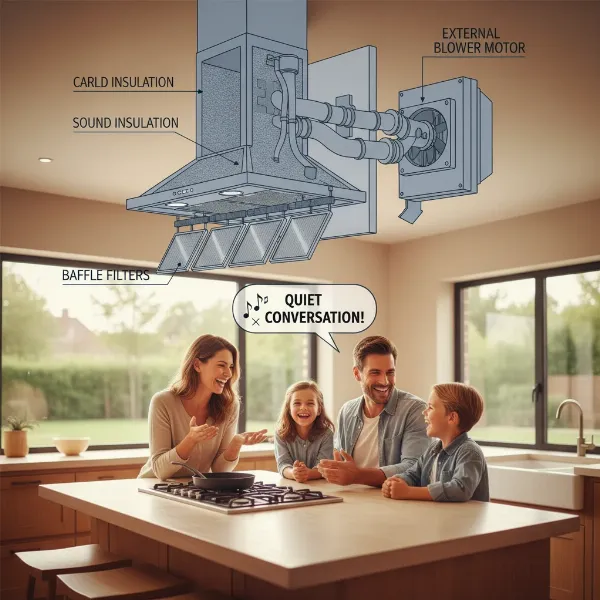 A cross-section of a range hood highlighting quiet operation features like baffle filters and sound-dampening insulation, with a person comfortably conversing nearby.
Conclusion: Crafting Your Ideal Culinary Environment
Selecting the best island range hood for your open-concept kitchen is a decision that significantly impacts both the functionality and aesthetics of your home. By carefully considering factors like suction power, noise levels, size, design, and features, you can ensure your kitchen remains a fresh, inviting space, free from lingering odors and airborne contaminants. From my extensive experience, investing in a high-quality island range hood is not just about ventilation; it’s about elevating your entire culinary experience and protecting your home’s ambiance. What culinary adventures will you embark on now that your kitchen is perfectly equipped?
Frequently Asked Questions
What is the ideal mounting height for an island range hood?
The ideal mounting height for an island range hood is typically 24-30 inches above an electric or induction cooktop, and 30-36 inches above a gas cooktop. This range ensures optimal smoke and odor capture while maintaining safety clearances and clear visibility for cooking.
Can island range hoods be ductless?
Yes, island range hoods can be ductless. However, ducted systems that vent outside are generally recommended for open-concept kitchens as they are far more effective at removing grease, heat, moisture, and odors, which is crucial for maintaining air quality in a shared living space. Ductless models recirculate filtered air and require regular charcoal filter replacements.
How do I maintain my island range hood’s filters?
Maintenance depends on the filter type. Mesh and baffle filters are often dishwasher-safe and should be cleaned monthly to prevent grease buildup, which can impede airflow and increase noise. Charcoal filters in ductless hoods are not washable and typically need to be replaced every 3-6 months, depending on cooking frequency.
Why are island range hoods more expensive than wall-mounted ones?
Island range hoods are generally more expensive due to their complex design and structural requirements. They need to be finished on all sides for aesthetic appeal, often feature more powerful motors to counteract cross-drafts in open spaces, and require specialized ceiling mounting and ducting, which can add to installation costs.
How wide should an island range hood be compared to the cooktop?
An island Range Hood should be at least as wide as your cooktop. For optimal performance, especially with heavy cooking, it is often recommended to choose a hood that is 6 to 12 inches wider than your cooktop, providing a larger capture area for smoke and steam.